Running low on fuel while driving on an unfamiliar stretch of highway triggers an immediate, stressful question: exactly how much distance can your vehicle travel before the engine sputters and stops? Relying solely on a glowing low fuel indicator light can be nerve-wracking, as different makes and models trigger these warnings with varying amounts of fuel remaining in the tank. By mastering the core mathematics behind vehicle range anxiety math, you can accurately estimate your remaining distance, assess whether you can safely reach the next service station, and eliminate the guesswork from emergency driving scenarios.
In this comprehensive guide, we examine the fundamental formulas, variables, and practical calculation steps required to determine remaining driving range. Whether you are analyzing your vehicle's baseline efficiency or planning a detour, understanding how to compute distance-to-empty metrics protects you from unexpected roadside delays. For broader journey planning, pairing these insights with a specialized Speed Distance Time Calculator and a reliable Fuel Cost Calculator ensures your entire route remains economical and predictable.
To truly master this discipline, one must look beyond the basic dashboard light and understand the underlying physics of fluid dynamics, internal combustion engine efficiency, and mechanical tolerances. This guide provides a rigorous analytical framework for evaluating your remaining journey capacity under distress.
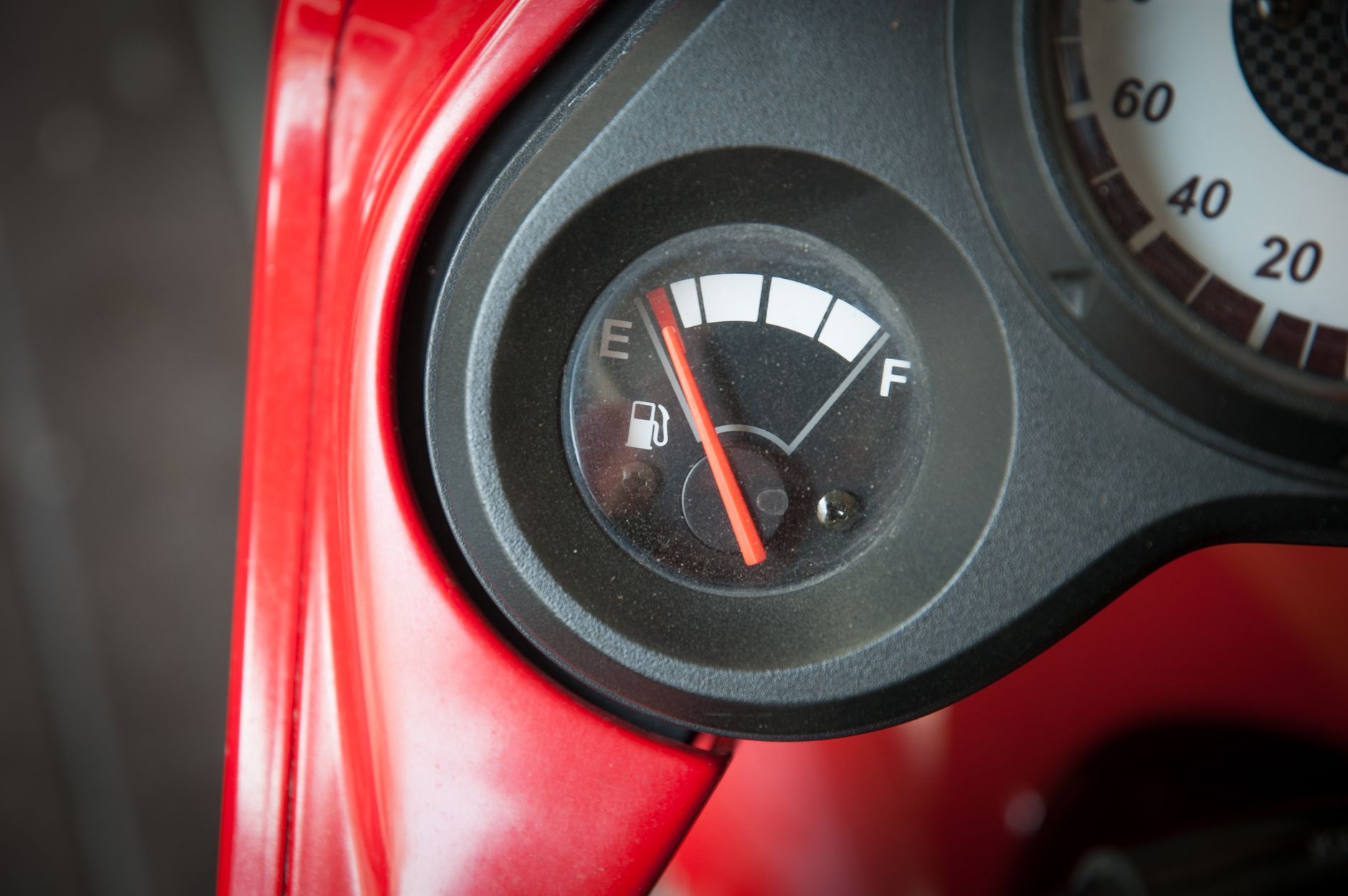
The Core Formula for Remaining Vehicle Range
To calculate how far your car can travel on the fuel currently left in your tank, you need three primary pieces of data: your remaining fuel volume (in gallons or liters), your current fuel economy (in miles per gallon or kilometers per liter), and a safety reserve factor. The fundamental mathematical relationship is straightforward:
Remaining Range = Remaining Fuel Volume × Fuel Economy
However, real-world driving rarely operates under laboratory conditions. Variables such as idle time, heater usage, uphill grades, and highway speeds dramatically alter actual fuel consumption rates. Therefore, responsible drivers apply a safety margin to the raw mathematical output to account for unpredictable fuel burn rates.
Expanding upon this baseline expression, we can integrate additional variables to refine our calculations. Let us examine the expanded mathematical model:
Adjusted Safe Range = (V_rem - V_reserve) × FE_adjusted × C_env
Where V_rem is total remaining fuel, V_reserve is the unusable bottom sediment buffer, FE_adjusted is real-time environmental fuel economy, and C_env is an environmental correction coefficient for temperature, wind, and elevation changes.
Defining the Variables
- Remaining Fuel Volume ($V_{rem}$): The estimated volume of usable fuel left inside the tank, expressed in gallons or liters.
- Fuel Economy ($FE$): The efficiency with which your vehicle converts fuel into distance, expressed as Miles Per Gallon (MPG) or Liters per 100 Kilometers ($L/100km$).
- Safety Reserve ($R_{safe}$): A buffer percentage (typically 10% to 20%) subtracted from the total calculated range to guard against inaccurate fuel gauge readings and steep inclines.
- Adjusted Range ($AR$): The conservative, actionable distance you can safely plan to travel before finding a fuel station.
- Environmental Correction Coefficient ($C_{env}$): A multiplier ranging from 0.75 to 1.0 that accounts for heavy headwinds, sub-zero ambient temperatures, or steep mountainous terrain.
Step-by-Step Guide to Calculating Distance-to-Empty
When you notice your fuel gauge dropping into the red zone or your dashboard warning chime sounds, execute the following steps to evaluate your situation mathematically:
- Estimate Remaining Fuel Volume: Check your owner's manual for your vehicle's total fuel tank capacity. If your gauge shows one-quarter tank remaining on a 16-gallon tank, your estimated remaining volume is approximately 4 gallons ($16 imes 0.25$).
- Determine Realistic Fuel Economy: Avoid using highway-rated MPG if you are currently crawling through dense city traffic or climbing steep mountain passes. Adjust your expected MPG downward by 15% to 20% to account for adverse driving conditions.
- Multiply Volume by Efficiency: Multiply your estimated remaining gallons by your adjusted MPG figure to find your raw theoretical range.
- Apply the Safety Margin: Multiply your raw range by 0.85 (deducting 15%) to establish your safety-buffered distance limit.
- Cross-Reference with Route Data: Compare your calculated safe distance against navigational markers or milestone signs to confirm whether your target exit or gas station is well within range.
Executing these steps calmly during a crisis prevents panic-driven decisions. By writing down or mentally noting your baseline parameters, you transform an ambiguous emergency into a controlled algebraic equation.
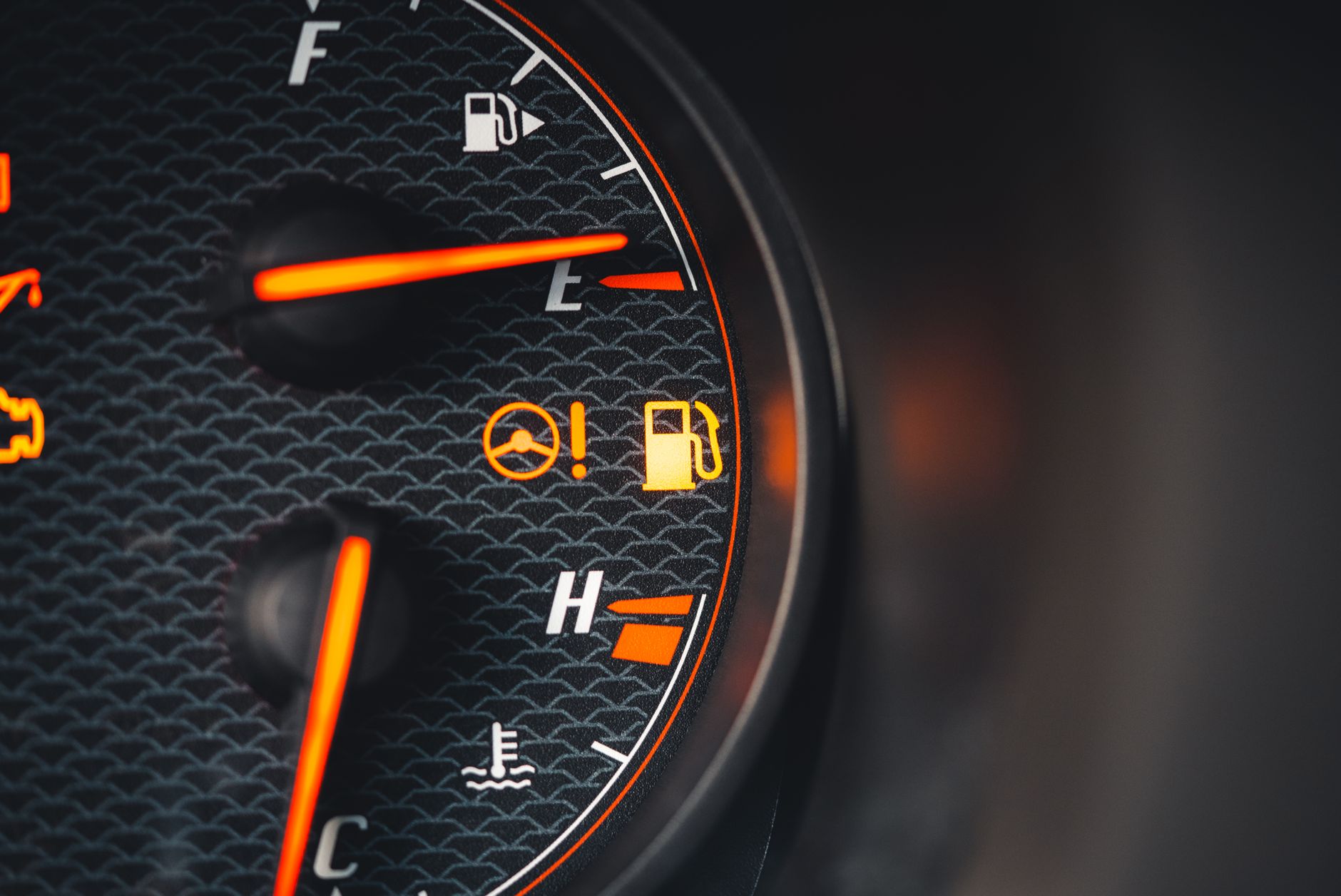
Worked Example 1: Highway Driving with a Partial Tank
Imagine you are driving a mid-size sedan on an interstate highway. Your vehicle has a total fuel tank capacity of 14 gallons. Your dashboard low fuel warning light has just illuminated, and your digital trip computer or physical gauge indicates you have roughly 2.5 gallons of fuel remaining.
Under normal highway cruising conditions, your car achieves approximately 28 miles per gallon (MPG). Let us calculate your maximum theoretical range and your safe operating range:
- Raw Range Calculation: Multiply remaining gallons by fuel economy.
2.5 gallons × 28 MPG = 70 miles - Applying Safety Reserve: To avoid cutting it dangerously close, apply a 15% safety buffer.
70 miles × (1 - 0.15) = 70 × 0.85 = 59.5 miles
Interpretation: While your car's theoretical absolute limit is 70 miles, your practical safety cutoff is approximately 59.5 miles. If the next available service plaza is marked as 45 miles ahead, you can proceed with confidence. However, if the next gas station is 65 miles away, you must exit early or reduce speed immediately to conserve fuel.
Furthermore, if you factor in an ambient headwind blowing at 20 mph, your effective aerodynamic drag increases. Applying our environmental coefficient ($C_{env} = 0.90$), our safe operating range drops further:
59.5 miles × 0.90 = 53.55 miles
This refined calculation proves that even on open highways, external atmospheric conditions demand continuous recalculation.
Worked Example 2: City Driving and Heavy Traffic Conditions
Now consider a different scenario. You are navigating urban streets during rush hour. Your compact SUV has 2.0 gallons of fuel remaining. While your vehicle is rated for 24 MPG on the highway, city stop-and-go driving reduces your actual fuel economy to 18 MPG.
Let us calculate your remaining distance under these less efficient operating conditions:
- Adjusted Raw Range Calculation:
2.0 gallons × 18 MPG = 36 miles - Applying Safety Reserve (20% buffer for heavy traffic/idling):
36 miles × 0.80 = 28.8 miles
Interpretation: Despite having the same low volume of fuel as the highway example, your city range drops dramatically to under 29 safe miles. Idling at traffic lights and frequent acceleration consume disproportionate amounts of fuel, reinforcing why context-specific MPG estimates are essential for accurate math.
In urban environments, every stoplight represents an energy loss where kinetic energy is converted into waste heat via brake pads, requiring fresh fuel burn to restore momentum. Drivers must account for this frequent stop-start cycle by inflating their safety buffer to at least 20%.
Common Mistakes in Fuel Range Estimation
Drivers frequently miscalculate their remaining distance due to several persistent misconceptions:
- Trusting the Fuel Gauge Linear Assumption: Many fuel gauges do not drop linearly. The top half of the tank often depletes much slower than the bottom half due to the physical shape of the fuel tank and float sensor placement. Never assume that the distance covered on the first half of the tank equals the distance possible on the final quarter.
- Ignoring Auxiliary Loads: Running high-draw electrical appliances, defroster fans, and air conditioning compressors places additional load on the engine alternator, slightly increasing fuel consumption. When calculating tight margins, factor in these energy draws.
- Failing to Account for Elevation Changes: Climbing steep mountain grades requires significantly more engine power than descending or cruising on flat terrain. Uphill driving can cut your effective MPG in half, rendering simple flat-ground range calculations dangerously optimistic.
- Forgetting Reserve Capacities: Most modern cars include a hidden reserve volume (typically 1 to 2 gallons) after the digital display reads "0 miles to empty." While this is a helpful safety buffer designed by engineers, treating it as a reliable, repeatable driving buffer is a recipe for getting stranded.
- Neglecting Tire Pressure Dynamics: Low tire pressure increases rolling resistance. Under-inflated tires can reduce fuel economy by up to 3% for every 3 PSI drop below the recommended manufacturer specification, silently draining your remaining distance budget.
Strategic Tips for Extending Vehicle Range
If your calculations reveal that your destination is dangerously close to your remaining range limit, you can actively alter your driving behavior to stretch your remaining fuel:
- Moderate Your Speed: Aerodynamic drag increases exponentially with speed. Cruising at 55 mph instead of 75 mph can improve fuel economy by 15% or more on many passenger vehicles.
- Utilize a Speed Converter if you cross regional borders with unfamiliar speed limit units to ensure you maintain optimal efficiency speeds.
- Maintain Steady Momentum: Avoid aggressive acceleration and heavy braking. Anticipate traffic flow so you can coast gently toward red lights rather than accelerating right up until the stop.
- Minimize Idling: If you are pulled over waiting or caught in stationary gridlock, turn off the engine if the stop is expected to last longer than one minute. Idling burns fuel while achieving zero distance.
- Optimize Cabin Climate Controls: Turn off the air conditioning compressor if weather permits, as powering the AC unit increases engine load and fuel burn.
- Use Drafting Techniques Safely: On highways, maintaining a safe, stable following distance behind a large semi-truck reduces aerodynamic drag on your vehicle. However, ensure you never tailgate, as doing so compromises reaction time and negates safety margins.
Decision Checks for Low Fuel Emergencies
When facing a low fuel warning, run through this quick decision check matrix to determine your immediate course of action:
- Check Distance to Next Exit: Is a gas station within 15 miles? If yes, maintain a steady 55 mph and proceed.
- Evaluate Traffic Density: Are you in free-flowing traffic or gridlock? If gridlock, exit the highway immediately at the next available ramp to avoid prolonged idling.
- Assess Weather and Road Grade: Are you climbing a mountain or facing strong headwinds? If yes, apply an extra 20% safety reduction to your estimated remaining distance.
- Audit Electrical Draw: Are seat heaters, rear defrosters, and high-beam headlights active? Switch off all non-essential electrical accessories to reduce alternator load.
Frequently Asked Questions
To help clarify further, here are answers to common questions regarding vehicle range calculations and low-fuel driving.
How many miles can you typically drive when the low fuel light comes on?
Most passenger vehicles have roughly 1 to 3 gallons of reserve fuel remaining when the warning light triggers. Depending on your vehicle's fuel economy, this generally translates to between 30 and 50 miles of driving distance under normal conditions.
Why do digital distance-to-empty readouts fluctuate while driving?
Digital readouts calculate remaining range dynamically based on your rolling average fuel economy over the last several minutes or miles. If you transition from smooth highway cruising to steep hill climbing or stop-and-go city traffic, the computer recalculates your efficiency instantly, causing the estimated range number to drop.
Can I damage my car by driving until the fuel tank is completely empty?
Yes. Modern fuel pumps are submerged inside the gas tank and rely on gasoline for cooling and lubrication. Running the tank completely dry can cause the fuel pump to overheat and fail prematurely. Furthermore, running on empty can pull sediment from the bottom of the tank into your fuel injectors and filters.
How does temperature affect my remaining driving range?
Extreme cold weather negatively impacts fuel economy because engines take longer to reach optimal operating temperatures, thick gear oils increase mechanical resistance, and dense winter fuel blends possess slightly lower energy density. Consequently, your winter driving range on low fuel will typically be lower than your summer range.
What tools should I use to plan long road trips with fuel stops?
For comprehensive trip planning, combine distance calculators with a dedicated Trip Cost Calculator to estimate total fuel expenses and map out planned refueling stops before you encounter low-fuel stress.
Does the grade of gasoline affect my distance-to-empty calculations?
Generally, standard regular unleaded gasoline provides the same energy density as premium fuel. Unless your engine specifically requires high-octane fuel to prevent knocking and maintain optimal ignition timing, switching fuel grades will not noticeably alter your remaining driving range.
How accurate are smartphone navigation apps in predicting fuel stops?
Modern navigation apps provide accurate distances to upcoming gas stations along your route, but they do not know your exact instantaneous fuel tank level. Always cross-reference their station listings with your manual math and safety buffer calculations.
Conclusion
Vehicle range anxiety is an uncomfortable experience, but it can be effectively managed through calm mathematical calculation rather than panic. By multiplying your verified remaining fuel volume by an appropriately adjusted fuel economy figure—and always applying a reliable safety buffer—you can determine your true distance-to-empty limits. Whether you are navigating interstate highways or urban corridors, combining smart driving techniques with precise route math ensures you reach your destination safely and efficiently every time.
Found this calculator guide useful? Support more free tools.
Buy Me a Coffee
Comments
Post a Comment